

How Many Restrooms Does a County Fair Need in Sandy Springs?
Start with headcount, not guesswork. A fair pulling steady foot traffic over a full day needs more capacity than a one-night carnival, and our placement guide walks through the math event organizers actually use. For general sanitation planning, OSHA 1926.51(c) sets construction-site ratios as a reference point: one toilet for 20 workers or fewer, scaling up from there. Fairs draw heavier and more concentrated crowds than a job site, so we usually run tighter spacing near stages, food rows, and livestock barns.
If your fair sets up near downtown Sandy Springs or out toward the Roswell side of the county, distance from our yard matters less than layout does. Roswell sits 10.7 miles north, Brookhaven 6.2 miles south, so most fairgrounds in this stretch land well within a normal same-day delivery window. We stock standard portable toilets for general crowd flow, deluxe flushable units for VIP or sponsor areas, and ADA-accessible units that meet the 60 inch turning circle called out in ADA Standards section 304.3.1. Ground surfaces under and around each unit need to stay stable and slip resistant per ADA Standards section 302.1, which matters on grass midways after rain. For big multi-day fairs, a restroom trailer with running water often beats a wall of single units, and our 4-stall or 8-stall trailers handle heavier flushable demand near grandstands.
What Does a County Fair Restroom Package Cost?
Pricing depends on unit mix and how many days the fair runs. Multi-day fairs usually mix standard units for the midway with a trailer or two near the main stage, and delivery fees apply once per site rather than per unit.
| Unit type | Day | Week |
|---|---|---|
| Standard portable toilet | $100 - $350 | $130 - $500 |
| ADA-accessible unit | $200 - $400 | $240 - $400 |
| Restroom trailer | $175 - $2,500 | $1,650 - $2,500 |
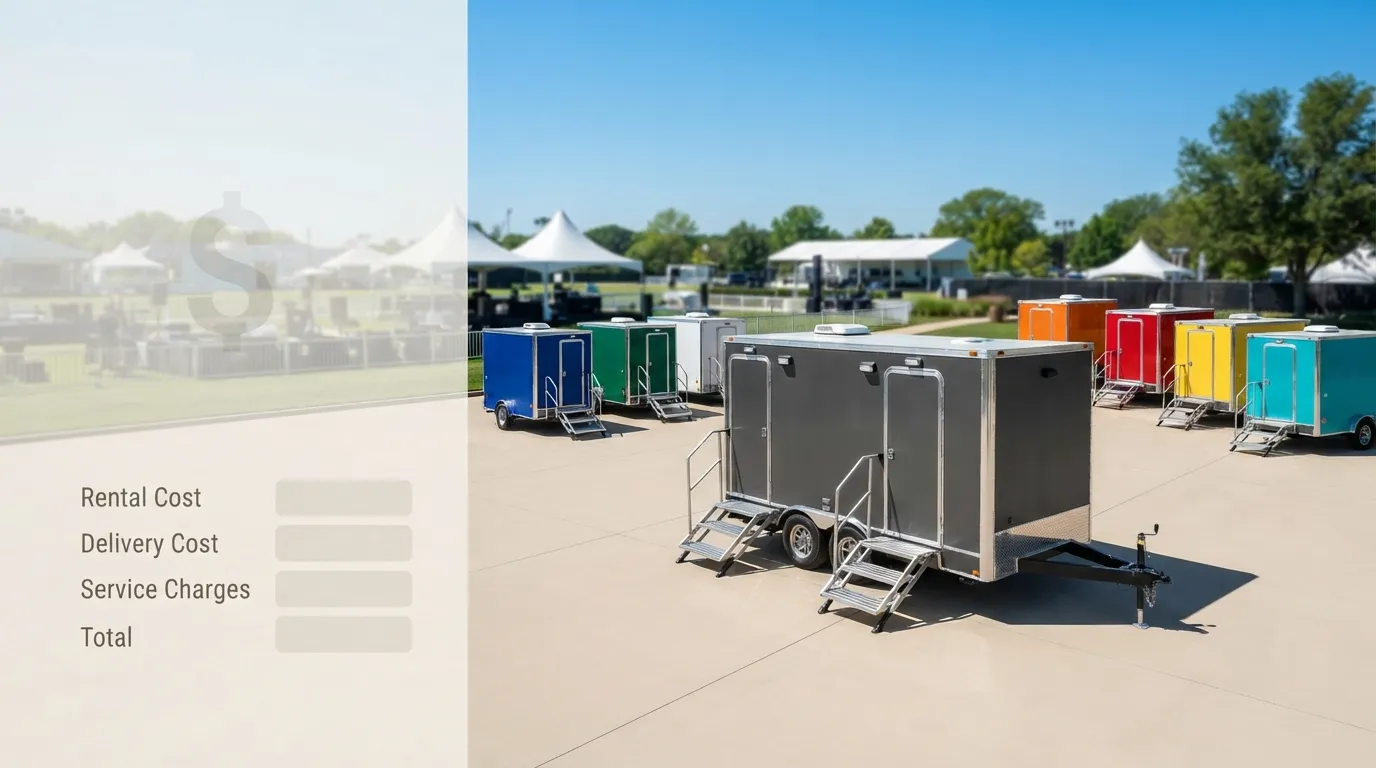
Event-length standard unit rentals run $200 to $800 for a defined event window rather than a flat day rate, which fits a three or four day fair better than a daily quote. Delivery runs $100 to $500 depending on distance and site access, and a service fee of $100 to $300 covers the pump-out and restock visit. Check our full cost breakdown or the per-day pricing page if you are comparing a single weekend against a longer run, and see restroom trailer cost for trailer-specific numbers. Fairgrounds with grease-heavy food vendors sometimes need a grease trap pumped too, since interceptors get serviced once fats, oils, grease and solids reach 25 percent of the liquid depth.
Can Sandy Springs Porta Pros Handle Multi-Day Fair Events?
Yes. Multi-day fairs need a servicing rhythm, not a one-time drop. ANSI/PSAI Z4.3 sets a baseline service interval of once per week for light use, but a county fair running four days straight with thousands of guests needs daily or twice-daily service on high-traffic units, especially near food courts and animal barns. We build that schedule into the quote up front instead of leaving it as an afterthought.
Handwashing matters as much as toilet count. Any vendor booth applying paints, coatings, or pesticides on-site triggers washing facility requirements under OSHA 1926.51(f)(1), and general handwashing setups near food vendors and livestock areas should carry soap and towels or a hand-drying device per 29 CFR 1910.141(d)(2), not just sanitizer. We supply handwashing stations and portable sinks sized for exactly that. Access paths between units need to stay at least 36 inches clear under ADA Standards section 403.5.1, and any accessible unit door needs a 32 inch clear opening under ADA Standards section 404.2.3.
For a fairground that also brings in food trucks, judging tents, and equipment storage, we pair restrooms with roll-off dumpsters for trash, temporary fencing for crowd lanes, and storage containers for supplies between fair days. Sandy Springs organizers running fairs near Marietta-area satellite lots, 15.8 miles west, often add a light tower for evening hours. Compare notes with our festival restroom guide or the broader event restroom page before you finalize your layout.
How far in advance should I book restrooms for a county fair?
Book 4 to 6 weeks out if possible, especially for trailers, since event-length trailer rentals run $2,499 to $3,899 and demand climbs fast during fair season. Standard units are easier to add late, but ADA units and trailers sell out first. Use our quote form to lock dates early.
Do I need ADA-accessible units at a county fair?
Yes. ADA Standards section 213.2 requires at least 5 percent of clustered single-user units to be accessible, with a minimum of one no matter how small the cluster. A fair with ten standard units still needs at least one ADA unit on site.
How often are restrooms serviced during a multi-day fair?
Daily service is standard for fairs running several days with steady crowds, ahead of the once-weekly baseline in ANSI/PSAI Z4.3. High-traffic units near food rows or main stages sometimes get serviced twice a day. See our cleaning schedule guide for specifics.
What size restroom trailer fits a county fair?
An 8-stall trailer suits fairs expecting a few thousand daily visitors, while a 2-stall or 4-stall works for smaller community fairs. Compare the 2-stall, 4-stall, and 8-stall options against your expected gate count.
Can restrooms be placed on grass fairgrounds?
Yes, as long as the ground stays stable and slip resistant under ADA Standards section 302.1. We check site access before delivery, since placement on soft or sloped ground affects both safety and service truck access.
Next step
Get a delivery date
Tell us the address, the dates and the headcount. We size the order and confirm the route.